Iterating Beyond Software: Agile Outside of Code
iterating beyond softwareWhat does 'working software' mean when you don't build software? How Done Increments and empirical delivery apply in consumer goods, pharma R&D, and beyond.
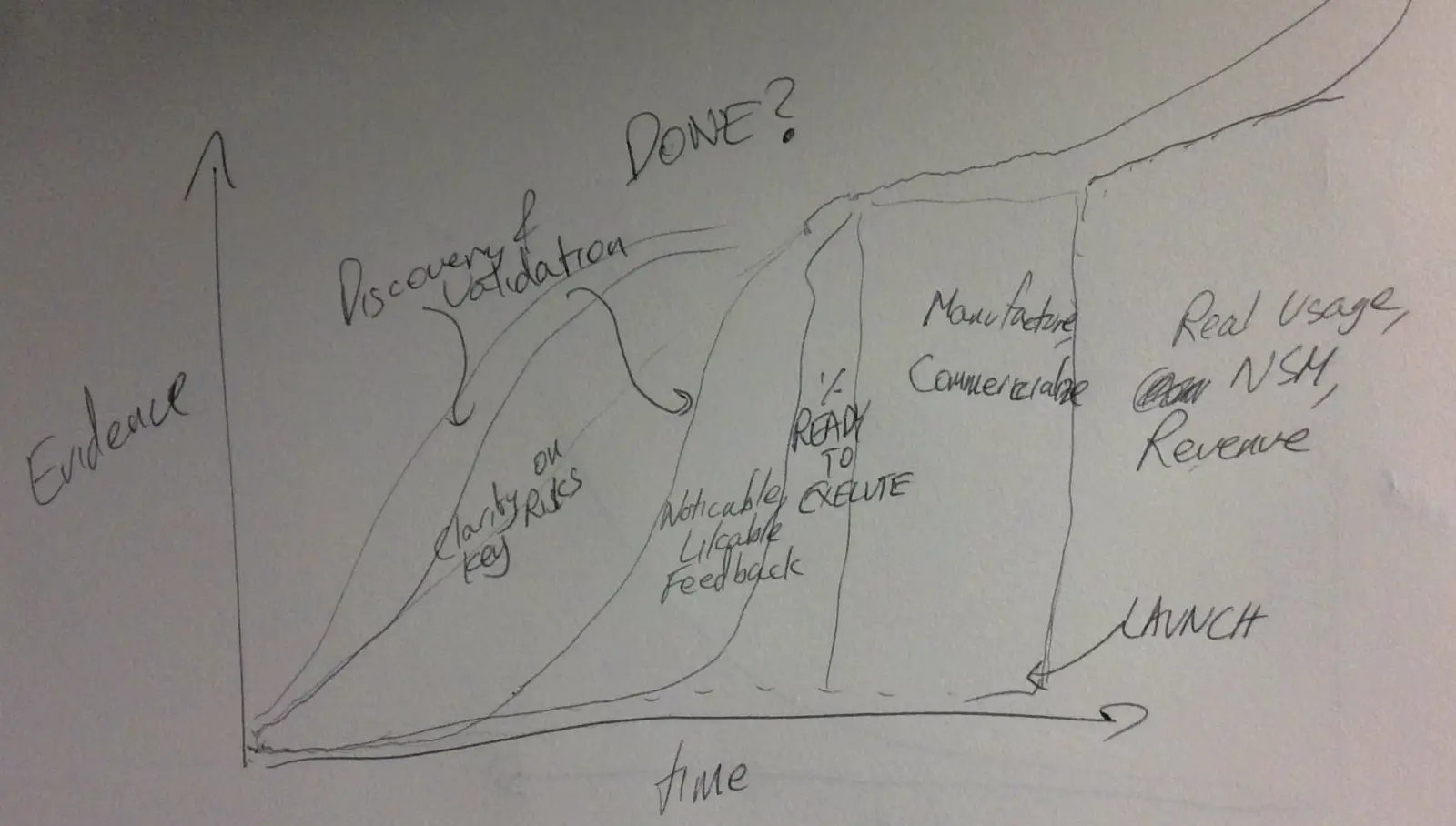 Click image to open full size
 Working Software. Done Increments. Two related concepts in the agile world that people trying to leverage Agile and Scrum’s empiricism outside of the software and technology space struggle with.
The intent behind these practices is to achieve transparency to validate or invalidate assumptions: you might call it managing based on evidence. The key idea is to get transparency as early and often as possible, to minimize the risk of continuing down the wrong path.
The assumptions we are actually derisking
The assumptions we’re making could be in areas such as desirability (will they want it?), viability (can we make money on it?), feasibility (can we do this? can we make this?), or sustainability (can we do it in a way that is sustainable for our people, society, and world?).
We’re making such assumptions whether we’re building a fully digital product based on software, a cyber-physical system involving software and hardware, consumer goods (think laundry care, grooming, beverage and food products) or even when we’re not designing and building a product at all but tackling a complex problem. For example, how to get from initial indication to FDA approval as quickly as possible while navigating unknown competitive threats, clinical trial results, and regulatory environment.
There’s still a need for transparency and derisking leap-of-faith assumptions, but accommodating the “transparency every couple of weeks” that agile ways of working suggest is a non-trivial challenge.
Where increments come easily
Some environments are easier to get working increments in. If we’re developing a new laundry care formula or a new beverage or food formulation, it’s possible to tweak the formula pretty quickly, and if you have a good setup for testing with your customers, like my clients in this space do, they can get this in front of customers soon thereafter. A test kitchen is an excellent example of this in action.
What if we’re making a physical product such as a razor? Sometimes it’s possible to test via 3D printing parts. This would be a compromise, because they’re not the real thing, but in many cases they’re good enough from a fidelity perspective and the earlier feedback is worth it.
And where they don’t
What if we’re working on that FDA approval challenge? What is it that we’re seeking here? You could suggest “just put your submission package in front of the FDA every couple of weeks,” and brace for the mix of laughter and ridicule that will ensue.
So what instead? It won’t be full transparency, but you could have a mock panel every couple of weeks with people who have enough experience about what the real panel will be looking for. The work done towards an increment to bring before this panel will be structured to enable a holistic review of where we stand. Of course it won’t be complete, but hopefully one risky aspect could be developed holistically so we can get feedback on it.
This approach is also quite useful when designing consumer goods. Feedback from consumers is just one area of assumptions. In order to steer based on evidence we need to look at the holistic proposition: not just desirability but also viability, feasibility and sustainability. Most consumer goods companies have a gating mechanism, and these are considered before greenlighting a production or commercialization phase.
If this is your context, you can try reviewing the next gate criteria and structuring a lightweight review that explores as many of these criteria as possible in a lower-fidelity manner. Why? Going for high fidelity will require much more time, and it’s better to have feedback along the way.
The tradeoff to actually reason about
There’s no one answer here. What you want to do is look at the tradeoff between delayed feedback on your decisions and assumptions, the risk of inaccurate feedback due to the fidelity of the increment, and the cost of creating each of these increments.
Remember where we started: we want early and frequent transparency that enables us to steer using evidence. Practices like Scrum’s definition of a done increment should serve that intent in our context.
Also remember that the definition of done can change over time. In this context it might be useful to start with increments that eat into discovery, then validation (as we discuss in the Professional Product Discovery and Validation Workshop), and eventually readiness to execute the manufacturing and commercial motion.
Reflecting back on the Think It, Build It, Ship It, Tweak It model, the work described above is taking place in the Think It and Build It stages, because moving from Build It to Ship It is a considerable cliff in these environments.
Impact Corner
Non-Software Done Increments Across Industries
| Industry / Domain | What the “Done Increment” Looks Like | What It Derisks |
|---|---|---|
| Consumer Goods / Food & Beverage | Test-kitchen formula batches with consumer taste panels. | Desirability & Taste Profile before factory line tooling. |
| Physical Hardware / Devices | 3D-printed rapid prototypes and ergonomic mockups. | Form-factor ergonomics & mechanical feasibility. |
| Biotech / Pharma Regulatory | Bi-weekly mock advisory panels with veteran regulatory experts. | Protocol validity & compliance gaps before formal FDA filing. |
Prompt for Designing Non-Software Increments
Help us design an empirical 'Done Increment' for a non-software initiative.

Given our physical, regulated, or operational challenge:
1. Map the 4 assumption categories: (a) Desirability, (b) Viability, (c) Feasibility, (d) Sustainability.
2. Identify the single highest-risk assumption currently blocking confidence.
3. Design the lowest-cost, lower-fidelity prototype or mock review panel that can validate or invalidate that assumption within two weeks.Practical thinking on turning AI pilots, adoption, and portfolio work into business impact - by finding the constraint, changing the work, and proving value as you go.
Yuval Yeret helps product and tech leaders move from agile theater to evidence-informed delivery. Work with Yuval →
- 01 What Is Agile Marketing 10 min
- 02 Add Real Learning to Your Agile Marketing Flow 5 min
- 03 Scaled Agile Marketing: An Overview 11 min