Sometimes it's safer to take a guided tour rather than explore on your own using a tour book
just because you hate guided tours doesnt mean you need to hate safeGuided tour or guidebook? Why criticizing SAFe's prescriptiveness misses the real question: what problem are you actually trying to solve?
 Click image to open full size
 (This post is based on content which originally appeared in an interview I gave InfoQ for Lean Kanban France 2014)
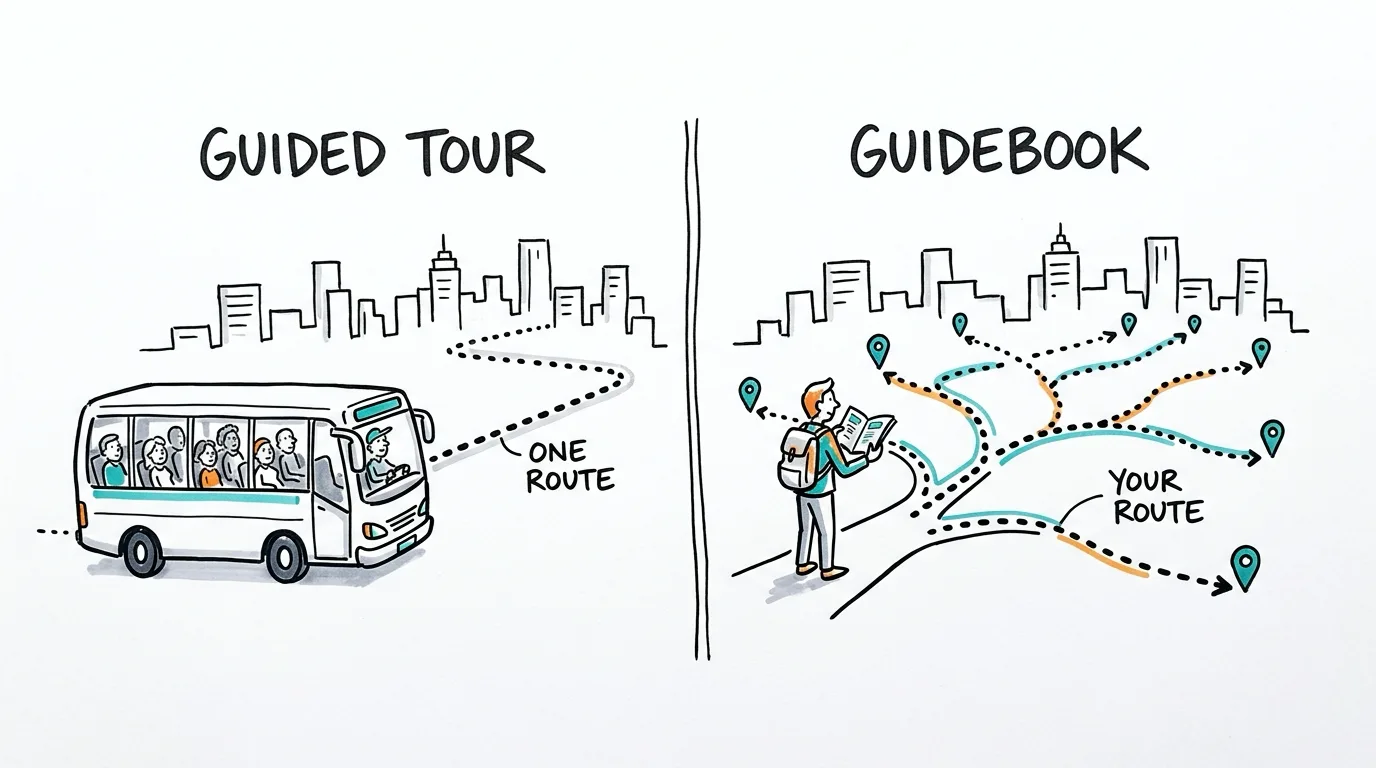
A pattern I recognized on enterprise agile transformations is the difference between the guided tour and the guide book approaches to change management.
Guided tour or guide book?
This pattern is about the choice people have to make between following a big, organized, prescriptive framework, or basing their decisions on principles and then choosing the different practices that make sense along the way.
Let’s say you go and visit Paris, or London, or Moscow, or Tel Aviv. How do you run your visit? Some people would take a guided tour that goes through all of the highlights and does all of the thinking and decision making for them, and doesn’t give them any options. Some other people would read some guide books, or use Yelp or the local Time Out, or ask friends, or even make decisions along the way: have some plans, some options that they would like to look at. I use bookmarks in Yelp, or a Google Map with the things that I’d like to do, but they don’t tell me what would happen on each day. I don’t make those decisions up front. I come to the city, see what is going on, and choose from the options along the way.
Applying it to scaling agile
Now let’s try to apply this thinking to the world of scaling agile, and look at SAFe (The Scaled Agile Framework) for example.
SAFe can be seen as a classic guided tour, aiming to satisfy the need of the mainstream masses for minimal choice and maximum safety by following in the footsteps of others: “best practices”. Seen as a guided tour, SAFe is well designed for the purpose and does its job well. Maybe too well, because as the ecosystem around it grows there are more and more people practicing and preaching SAFe who ONLY see it this way. That is a turnoff for people who want a guidebook rather than a guided tour, and I’m seeing more and more of those people turned off SAFe by this perception.
SAFe makes a good guidebook too
I think SAFe can be used as a great guidebook as well, and that is how I typically use it on my engagements. The most typical use these days is bringing some great ideas from SAFe into an engagement. Growing in popularity is looking at SAFe for inspiration and using its key aspects as a skeleton for how agile is going to look in the organization. And even those organizations that want to “do SAFe” still go through some customization period that makes sure they are starting off with a reasonable approach. The “inspect and adapt” aspect of SAFe should anyhow take care of adjusting the approach based on what happens in the trenches after starting.
From a change management perspective, all of these approaches have some ingredient of fair process: engagement of people in deciding how they are going to work, rather than management or a central change agent mandating the practices to them.
The harder question for a change agent
One of the things I am realizing is that as a change agent, what makes it complex is that what you should consider is not just your own personal preference for guided tours or guidebooks. It’s even more important to figure out what would be more effective for the client.
Sometimes the thing they actually need is the guided tour, despite our preference for the guide book. And vice versa. In most cases the right answer is a middle ground, or a mix: like that time we took a short architectural walk of Barcelona, which was one of the highlights of an otherwise unstructured getaway there.
Practical thinking on turning AI pilots, adoption, and portfolio work into business impact - by finding the constraint, changing the work, and proving value as you go.
Yuval Yeret helps product and tech leaders move from agile theater to evidence-informed delivery. Work with Yuval →