Actively Managing Portfolio Flow
actively managing portfolio flowA Portfolio Kanban is just a picture until you actively manage it. Here's what right-to-left portfolio review looks like, and why it sparks strategy talk.
 Click image to open full size
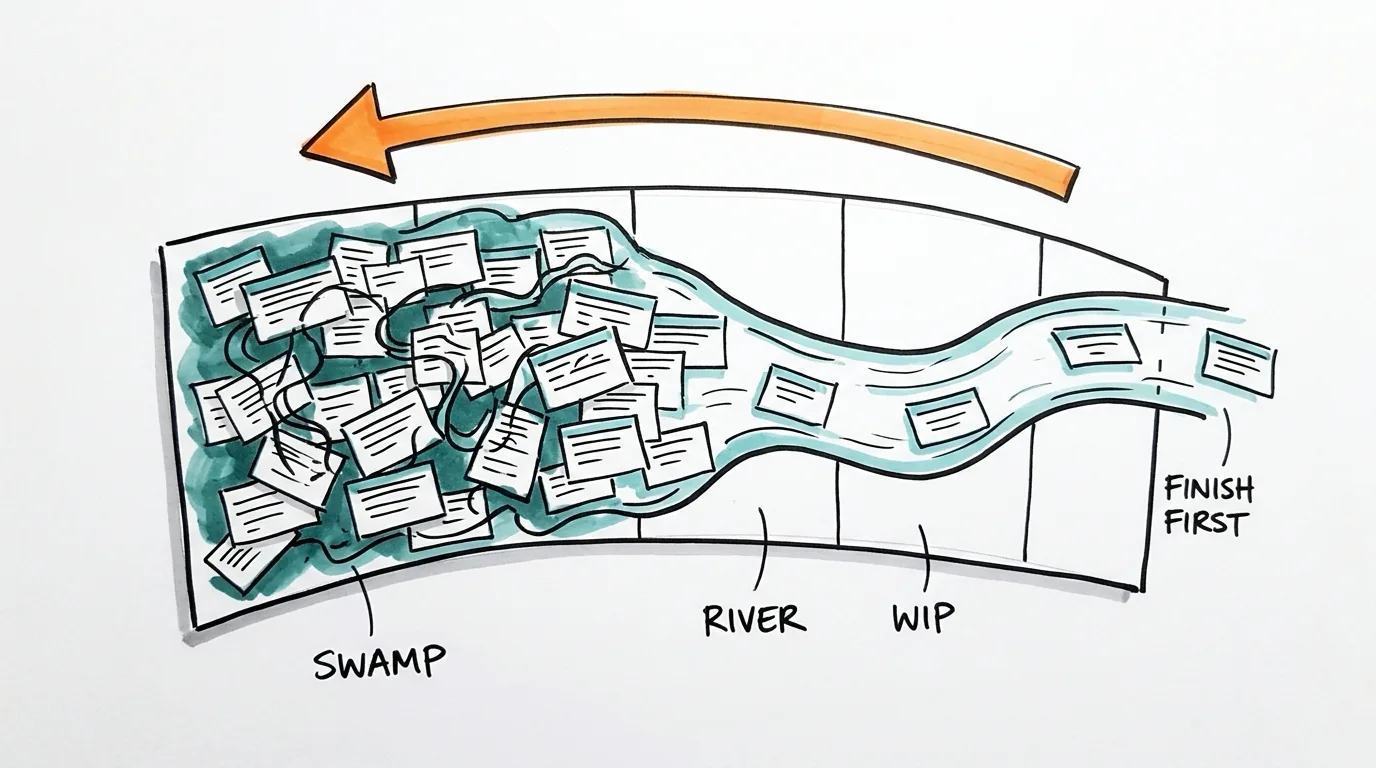
 Seeing the swamp is the first step in shaping it into a river.
You have a board. Now what?
You’ve established a Portfolio Kanban: a flow-based view of the significant work taking place in your organization. More likely than not, there are a lot of cards on that board, like a traffic jam in rush hour.
No New Work. Freeze. Differentiated Service. Applying WIP Limits. Those are patterns you can apply to start shaping the flow.
It might be as simple as reviewing the board and discussing the work right to left, instead of left to right the way work flows. By using this “Hebrew mode,” you are focusing on finishing work already in progress, and only getting to discuss starting new work after the weight of all the investments already in progress is essentially demotivating you from even considering it. Which is a nifty system to nurture a habit of stop starting, start finishing.
Constraints start showing up
As you start focusing on flow, you’ll begin to see constraints.
The one team or group involved in everything: maybe it makes sense to be even more careful when introducing new investments involving them. The investments that are so big they occupy their lane much more than others: maybe it makes sense to break them into independent investments, each worthwhile on its own, and accelerate time to market. Investments where you feel like you’re running blind, with no transparency about what’s really going on, and no leading indicators for months about whether this investment is going to be worthwhile, which can be an excellent opening for exploring outcome-oriented, evidence-informed portfolio management.
There’s so much that actively managing portfolio investments using a flow perspective can tell you, and so many opportunities for further improvement emerge organically. That’s the beauty of using Kanban: it catalyzes dialogues about improvement rather than telling people how to improve.
Actively managing flow on a Portfolio Kanban won’t magically turn a project-oriented organization into a product-oriented portfolio. But it is one of the most effective ways to start the journey.
Impact Corner
The Right-to-Left Portfolio Review Routine (“Hebrew Mode”)
| Step | Discussion Focus | Question to Ask |
|---|---|---|
| 1. Done-Adjacent Lanes | Items nearing completion or verification. | ”What specific blocker or review is preventing this from landing today?“ |
| 2. Active In-Progress | Items currently consuming team bandwidth. | ”Is anything stuck, aging abnormally, or starving downstream teams?“ |
| 3. Intake / Upstream | Proposed new strategic initiatives. | ”Given our current active load, do we have genuine capacity to pull this in?” |
Prompt for Facilitating a Right-to-Left Portfolio Review
Help us facilitate our leadership Portfolio Kanban review using a right-to-left flow protocol.

Given the list of active portfolio cards and their current column placements:
1. Start with the furthest right column (Validating / Ready to Ship) and draft questions to identify what is needed to close each item.
2. Flag any card that has exceeded expected cycle time or is waiting on a bottleneck shared team.
3. Enforce a strict 'stop starting, start finishing' rule: do not authorize pulling new work into active delivery until in-progress WIP drops below our agreed limit.
PS I’m working on a whitepaper about product portfolios in a product-oriented, evidence-informed world. What questions are you thinking about in the intersection of lean portfolios, product operating models, flow, and evidence-based management?
Since I wrote that: the flow metrics that sharpen this view are in Improving Portfolio Flow Using Flow Metrics, and the whitepaper became Scaling Product Organizations with Portfolio Agility.
Practical thinking on turning AI pilots, adoption, and portfolio work into business impact - by finding the constraint, changing the work, and proving value as you go.
Yuval Yeret helps product and tech leaders move from agile theater to evidence-informed delivery. Work with Yuval →